🌍Orders over US$49 ship free worldwide | Fast & secure delivery🚚🎁 Sign up & Earn rewards | Spend $200+ a year and unlock exclusive free gifts.📦 Tracked Worldwide Shipping | Follow Your Order Anytime
When it comes to electric vehicles in North America and Europe, one name continues to dominate global sales charts: the Tesla Model Y. For 2026, Tesla gave its best-selling electric SUV a major design, comfort, and technology overhaul—introducing sleeker exterior aerodynamics, a quieter cabin with a rear passenger touchscreen, and cutting-edge artificial intelligence features powered by Full Self-Driving (Supervised) v15 .
In this Westdrive review, we explore why the 2026 Tesla Model Y remains the benchmark electric crossover for families and tech enthusiasts alike.
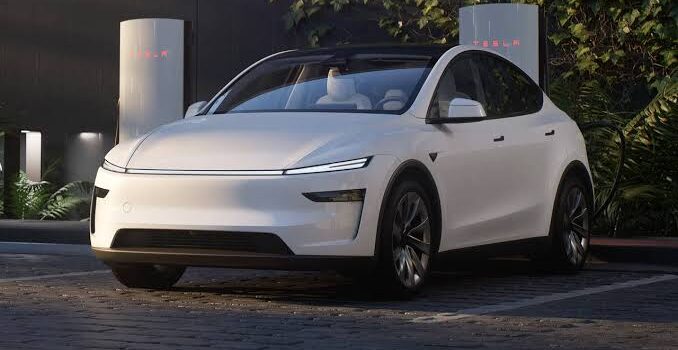
1. Exterior Design: Sleeker Aerodynamics and Full-Width Lighting
The refreshed 2026 Model Y leaves behind its older bulbous front end in favor of a sharper, more futuristic silhouette:
Full -Width Light Bars: Up front, a slim continuous LED light bar gives the Model Y a cyber-inspired look, matched at the rear by an indirect reflective light bar across the liftgate.
Improved Efficiency & Wheels: Aerodynamic refinements help slice through highway wind with less drag and cabin noise, paired with 19-inch Crossflow or 20-inch wheel options and hands-free power liftgate opening on approach.
2. Minimalist Cabin, Rear Touchscreen, and Grok AI
Step inside the 2026 Tesla Model Y, and the upgrades to ride comfort and in-cabin tech are immediately noticeable:
16 -Inch Front & 8-Inch Rear Touchscreens: A crisp 16-inch QHD central touchscreen controls navigation, climate, and entertainment, while rear passengers now enjoy their own dedicated 8-inch touchscreen for streaming movies, gaming, and adjusting rear climate controls.
Built -In Grok Voice Assistant: Integrated directly into Tesla’s infotainment system, the Grok AI assistant lets drivers ask natural-language questions, plan trips, and control vehicle functions hands-free.
Generous Cargo & 7-Seat Option: With 76 cubic feet of total cargo capacity (including a deep front trunk and under-floor storage) and an optional seven-seat configuration on AWD Premium models, the Model Y remains remarkably practical for daily family life.
3. Range, Performance, and 250 kW Supercharging
Tesla offers multiple configurations of the 2026 Model Y to balance long-distance range with sports-car acceleration:
Rear -Wheel Drive (RWD): Delivers an impressive EPA-estimated 348 to 357 miles of driving range while sprinting from 0 to 60 mph in 5.4 to 6.8 seconds depending on trim.
Long Range All-Wheel Drive (AWD): Dual motors drop the 0–60 mph time to 4.2–4.3 seconds while maintaining 327 miles of EPA-estimated range and a 3,500-pound towing capacity .
Model Y Performance (AWD): Unleashes blistering acceleration from 0 to 60 mph in just 3.5 seconds with sport-tuned suspension and track-ready dynamics.
Rapid Supercharging & Powershare: Plugging into Tesla’s 250 kW V3/V4 Supercharger network adds up to 169-182 miles of range in just 15 minutes . Plus, Vehicle-to-Load (V2L) capability allows the Model Y to power external tools, camping gear, or even back up a home when paired with Powerwall.
4. Ride Comfort and FSD v15 “Reality View”
One of the biggest improvements for 2026 is suspension tuning—soaking up broken pavement and highway expansion joints far more smoothly than earlier models. On the software front, Tesla’s latest Full Self-Driving (Supervised) v15 introduces Reality View , rendering a live, full-color 3D environment around the car alongside improved pothole detection, speed-limit awareness, and automated parking.
Pros and Cons
Pros :
Class-leading efficiency with up to 357 miles of range and seamless Supercharger access.
Refreshed styling, noticeably smoother suspension, and new 8-inch rear passenger screen.
Blistering acceleration (as quick as 3.5 seconds 0–60 mph in Performance trim).
Huge 76 cu. ft. Cargo capacity plus V2L external power outlets.
Cons :
No Apple CarPlay or Android Auto support (relies exclusively on Tesla’s native OS).
Almost all vehicle controls—including air vents and mirrors—require using the touchscreen or steering wheel buttons.
The Verdict
The 2026 Tesla Model Y successfully sharpens every strength that made it the world’s best-selling electric SUV. With up to 357 miles of range, a quieter and more comfortable ride, rear-seat entertainment, and unmatched charging convenience, it remains the standard by which all compact electric crossovers are measured.Rating : 4.8 / 5 Stars
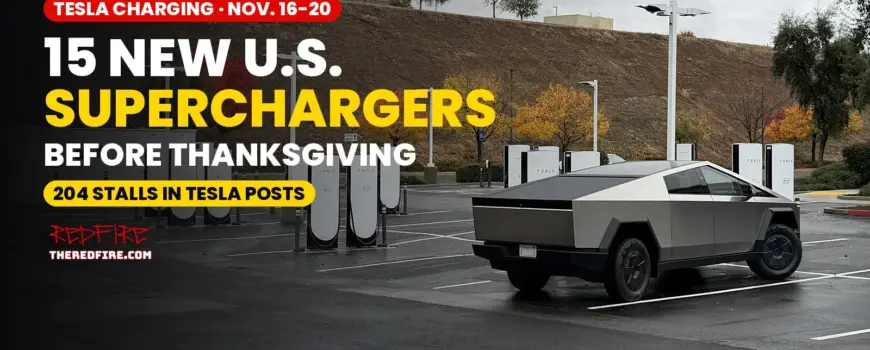
Yes. Tesla Charging, the company’s official charging account on X, posted 15 new U.S. Supercharger sites from Monday, Nov. 16, through Friday night, Nov. 20, 2026, the week before Thanksgiving. The stall counts in those posts add up to 204, by Redfire’s count. The newest is a 24-stall site in Millbrae, Calif., posted at 10:16 p.m. ET Friday. As of 6:30 a.m. ET Monday, Nov. 23, the account had posted no new U.S. sites since then.
The openings are part of what Max de Zegher, who posts as @MdeZegher and says he has been “Building Superchargers since 2014,” called a “big push” by Tesla’s U.S. Supercharger team. Chief Executive Elon Musk reposted(opens in new tab) the message on Nov. 17. Tesla has not issued a 2026 Thanksgiving travel advisory, and it has not said how busy highway Superchargers will be over the holiday weekend.
“Big push underway from the US Supercharger team to open new sites before Thanksgiving travel,” de Zegher wrote on X(opens in new tab) on Nov. 17, thanking utilities and local inspectors “keeping energizations of this critical infrastructure on track.”
The new U.S. Supercharger sites
Tesla Charging listed each location below as a new Supercharger and gave a stall count in the post. California got the most, with five sites. The South added Murfreesboro, Tenn.; Spanish Fort, Ala.; Benton, Ark.; and Centreville, Va. The Northeast added two New York sites, one in New Jersey and one in New Hampshire. Tesla did not say what time each site first took cars or what hours it keeps.
The Snohomish, Wash., site at Cathcart Crossing, with 4 stalls, is listed under Supercharger for Business, a site a business buys and Tesla adds to its network. The public Superchargers in the list total 14 sites and 200 stalls. Tesla Charging also posted new sites in Iceland, Hungary, the United Kingdom and Japan that week. Those are not counted here.
On Tuesday evening, Nov. 17, the account also posted a new Megacharger(opens in new tab) with eight stalls in Mesquite, Texas. Megachargers are built for the Tesla Semi, so it is not in the count. Passenger Teslas use Superchargers. Redfire earlier reported on the Megacharger in Conley, Ga.
Waitlist is live at 300 U.S. sites
Waitlist, Tesla’s virtual queue for Superchargers, is “now live at 300 Supercharger sites across the US,” Tesla Charging said(opens in new tab) at 5:29 p.m. ET Thursday, Nov. 19. Owners can join it in the Tesla app or on the car’s touchscreen, and Tesla says drivers of other EVs can join through the Tesla app. Tesla’s Waitlist support page(opens in new tab) describes it as available “at select Supercharger sites.” The post did not list which 300 sites have it.
Software 2026.44.1 also changed the in-car charging map, which now groups charger pins into clusters as you zoom out. Redfire covered that update in What Is Tesla’s Charger Network View in Software 2026.44.1?
How do I precondition my Tesla battery before Supercharging?
Use the car’s navigation to drive to the Supercharger. Tesla’s owner’s manual(opens in new tab) says the car “preconditions its high voltage Battery when navigating to Supercharger,” so it arrives at a battery temperature that cuts charging time. Recognized third-party fast chargers also start preconditioning when you set one as the destination in the car. Tesla recommends using Trip Planner to navigate to a charging location for at least 30 to 45 minutes before arrival, in both cold and hot weather. Preconditioning starts when you navigate to the Supercharger, even if Trip Planner is off. If the drive is shorter than that, the manual(opens in new tab) says to consider preconditioning the battery before you leave. That means scheduled preconditioning, or Climate and Defrost in the Tesla app, which the manual says “also warm the high voltage Battery as needed.” Tesla does not say that path will deliver the same charging speed as navigating to a Supercharger.
The Maps and Navigation chapter says to start that navigation this way:
Touch the search bar on the car’s map, then touch Charging.
Touch the pin for the Supercharger you plan to use. A popup appears.
Touch the arrow icon to start navigation to that Supercharger.
Redfire tip: Keep navigation running until you arrive, so the car can warm the battery on the way.
In cold weather, the motors can hum or whir while the car heats the battery on the way to a Supercharger. Tesla’s Normal Operating Sounds(opens in new tab) page calls that normal.
On a Cybertruck, navigating to a Supercharger or to a recognized third-party fast charger works the same way. For a third-party charger, set it as the destination, because Trip Planner will not add it as a stop on its own. Twisting red lines next to the battery icon show the battery is warming. Busy Superchargers may cap charging at 80% if you are not using Trip Planner. A Tesla Supercharger needs no adapter.
A manual preconditioning button is not live. It is in Tesla app 4.63.0 code but is not turned on yet, and Tesla has not announced it.
What Tesla has not said
As of Monday morning, Nov. 23, neither Tesla’s main X account nor Tesla Charging had posted 2026 Thanksgiving guidance on off-peak charging times, expected waits, or which highway corridors are likely to be busiest. Tesla has not published holiday charging statistics for this year. It has not said whether more U.S. sites will open before Thursday. The site count and stall totals above are only what Tesla Charging posted as new from Nov. 16 through Nov. 20.
Also in The Brief: How Should You Charge an EV? A Simple Guide for New Owners
FAQ
How many new Superchargers did Tesla open before Thanksgiving 2026?
Tesla Charging posted 15 new U.S. Supercharger sites from Nov. 16 through Nov. 20, 2026. The stall counts in those posts total 204.
Can I join a Supercharger waitlist?
Yes, at some sites. Tesla said Nov. 19 that Waitlist is live at 300 U.S. Supercharger sites, through the Tesla app or the car’s touchscreen.
Is there a precondition button in the Tesla app?
Not yet. It is in Tesla app 4.63.0 code but is not turned on. Navigating to a Supercharger still preconditions the battery.
The idea of owning and operating a Tesla vehicle as an everyday driver is far more grounded in reality today than it was when the electric-vehicle (EV) manufacturer introduced its O.G. Roadster in 2008. Driving a Tesla means never needing to refuel at a traditional gas station; it also means little to no traditional maintenance and freedom from emissions. But now, one of the biggest pros of Tesla ownership is access to the company’s extensive network of Superchargers. Located in all 50 U.S. states, at the time of writing, there are 3,135 Supercharger stations throughout the nation, equipped with 38,558 charging ports.
Tesla’s Supercharger ecosystem is open to all Tesla drivers, but the network was once fully privatized. It was only as recent as 2023 that the company introduced the Magic Dock adapter at Supercharger depots, making it possible to top off non-Tesla EVs. But now that Supercharger stop-offs aren’t private anymore (since 2023), most EVs that are compliant with Tesla’s North American Charging Standard (NACS) can be serviced at a Supercharger station.
This is particularly good news for the greater world of EV ownership, as Tesla plans to expand its Supercharger network even more. The company has plans to put up additional stations in a number of U.S. metropolitan areas and also intends to build more private stations to support its expanding fleet of Robotaxi vehicles.
Tesla publishes official Cybercab range and charging data
Tesla has now published the first official range and charging specifications for its Cybercab, marking a milestone in the model’s rollout. The figures, drawn from EPA testing and Tesla’s own order page, show the two-seat robotaxi’s high efficiency. They also highlight Tesla’s focus on balancing usable range with rapid recharge capability for high-utilization fleet operations.
279 miles EPA range
Official Tesla specification
123 miles Added in 15 min
Supercharging rate
Cybercab and Model 3 range and charging compared
Building on these figures, a comparison with the Model 3 shows the trade-off. The Tesla Cybercab is rated for an EPA-estimated 279 miles of range and can add 123 miles in 15 minutes via Supercharging. In comparison, the standard Model 3 Rear-Wheel Drive offers 314 miles of EPA range and supports up to 170 kW DC charging. The Model 3 Long Range extends this to 351 miles of EPA range with a peak DC charge of 250 kW.
Specification
Tesla Cybercab
Model 3 RWD
Model 3 Long Range
EPA range (miles)
279
314
351
Max DC charge power (kW)
100
170
250
Battery design choices behind Cybercab efficiency
This difference stems from deliberate battery design choices. Tesla’s Cybercab uses a small battery as a deliberate robotaxi design choice, enabling opportunistic charging between rides. Weight reduction improves efficiency by lowering structural requirements and related component mass. The smaller battery reduces material costs and shortens charging times. The Cybercab is designed to last 500,000 miles and features modular replaceable battery modules. Reserved space in the pack supports future LFP cell integration to maintain range despite lower energy density. The Cybercab uses a modular replaceable 4680-cell design.
Engineering factors shaping efficiency trade-off
The Cybercab’s small battery is a deliberate design choice for a robotaxi use case.
Weight reduction creates a virtuous cycle, lowering structural requirements.
A smaller battery reduces material costs and charging time.
Designed to last 500,000 miles and features modular replaceable battery modules.
Empty space in pack allows future LFP cells to maintain range.
The Cybercab uses a modular replaceable 4680-cell design.
Fleet economics shaped by Cybercab’s efficiency profile
These design choices also influence fleet economics and operational efficiency. Tesla claims a $0.30 per mile operating cost, which could offer fleet managers a margin advantage in dense urban markets if achieved. Its lightweight 3,113-pound design and smaller 48 kWh battery cut energy use and maintenance needs while speeding charging. High 92.40% resonant charging efficiency further reduces downtime, enabling quicker vehicle turnover for fleet operators.
$0.30
Claimed operating cost
Fuel, maintenance, insurance amortized
92.40%
Charging efficiency
Inductive resonant charging power transfer
48 kWh
Battery capacity
Smaller pack reduces material costs and charging time