
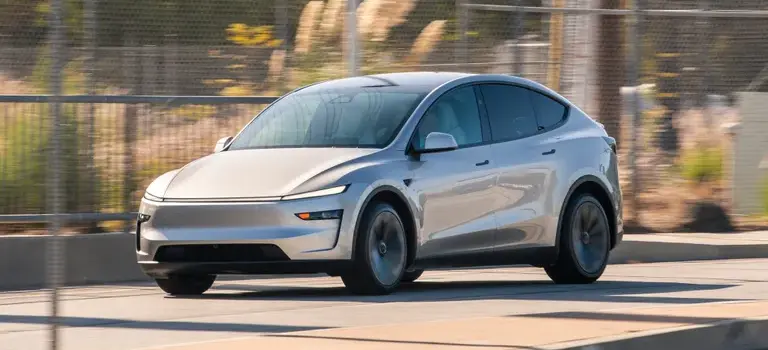
When Tesla ended production of the Models S and X earlier this year, not only did it say goodbye to its OG flagship sedan in the S, but it also bid farewell to its only true three-row SUV in America, with seats for up to seven adults. The first-generation Model Y had a three-row option packed into its tidy 188.6-inch overall length, which is still, oddly, available for purchase in the second-generation Model Y—but only in Premium AWD trim—for an additional $2,500. But the third row in that model is exceptionally tight on leg- and headroom and really only meant for children. All of this is why the new long-wheelbase, three-row, six-seat 2027 Model Y L makes a lot of sense in theory. But in reality? Let’s find out.
How Does It Drive?
We spent about two hours driving the Model Y L around MotorTrend’s offices in El Segundo, California, while simultaneously shooting photos, videos, and social media to accompany this story. From our time behind the wheel, we think the Y L’s driving dynamics are best understood from three different perspectives: old Model Y owner, current Model Y Performance driver, and someone new to Tesla.
MotorTrend bought a 2023 Model Y with the rare three-row option, and it currently has more than 42,000 miles on its odometer, which makes it the perfect baseline for comparison. But it’s no contest. In the first 50 feet of driving, it becomes obvious the Model Y L is significantly quieter and smoother than our occasionally harsh, always rattly Model Y. The large, head-tossing impacts that trouble our Y are fully contained in the Y L, while the busy, buzzy, belly-jiggling vibrations from rough or broken pavement are almost completely neutralized. Whether bopping around town or heading out on a long haul, the Model Y L is the answer, especially with the latest version of Full Self Driving (Supervised) enabled. We FSD’ed the Y L briefly on the streets near our office and found it as capable and intuitive as the system in our Model Y—in which we’ve logged nearly 7,000 miles of FSD since the version 14 update.

We happened to have the sport-tuned Model Y Performance on loan from Tesla during our time with the Y L, so of course we had to pit the siblings against each other. No surprise that the Y Performance is the varsity jock of the two, with more oomph from the accelerator, quicker steering response, and flatter cornering. The stiffer, sport-tuned dampers and lower-profile performance tires on the Y Performance transmit more road feel up through the steering wheel and seats, while the shorter wheelbase and quicker steering make it the obvious choice for whipping through canyons. That said, the Y L is no slouch when the accelerator is stabbed and brakes are dabbed; its ride is plush but retains just the right amount of tautness to accommodate spirited driving.
According to a Tesla chassis engineer we spoke with, the Model Y L and Y Performance share the same electronically controlled single-valve adaptive dampers, but they’re tuned differently. In the Y L, the chassis team developed two different ride and handling profiles, which you can toggle between in a menu on the touchscreen. As the name suggests, Balanced mode splits the difference between a smooth ride and sporty handling for the driver, while Rear Comfort mode aims to eliminate pitch, roll, and heave for the partygoers in the back. The engineer we spoke with said the driver should be able to feel a noticeable difference between the two modes, but we’re not sure we did during our brief city and freeway jaunts with the Y L. That said, we do appreciate Tesla’s focus on rear-seat passenger comfort, and we plan to load up a Y L and tackle twisty roads in future driving evaluations.
If you’re completely new to Tesla but familiar with the planted feel of skateboard-chassis EVs and the instant response of high-power electric motors, you may be pleasantly suprised by the Model Y L’s light feel and civilized road manners. Our drive was admittedly brief, but it revealed no real weaknesses. Is it the best driver in its class, no matter the powertrain? We need more time to make that call.
The L Stands for Longboi
At 195.6 inches long, the Model Y L is a full 7.0 inches longer than the Model Y. All but 1.1 inches of that stretch is between the wheels, as the Model Y L’s 119.7-inch wheelbase is 5.9 inches longer than the standard Model Y’s. The roof gains 1.7 inches of height, which should be welcome news for the occupants, particularly those in the third row. The Y L comes in only one seating configuration: driver and front passenger seat, twin captain’s chairs separated by an aisle in the middle row, and a bench seat for two in the very back.
Compared to the outgoing Model X, which is 199.1 inches long, 78.7 inches wide, and 66.1 inches tall, the Y L is 3.5 inches shorter in length, 3.1 inches narrower, with a roof height that’s 0.4 inch lower. But interestingly, the Y L’s wheelbase is 3.0 inches longer than the Model X’s, which doesn’t seem possible when looking at both from the side.
The Model Y L made its debut in China in June of 2025. According to Tesla’s Lars Moravy, the only differences between U.S. and Chinese models are the source of the battery, suspension tuning, and higher-power, ventilated mobile phone charging pads available in China.
Power and Performance
An 83-kWh nickel-manganese-cobalt-aluminum (NMCA) battery pack powers the Model Y L’s dual-motor all-wheel-drive system. The battery is made in Tesla’s battery plant in Reno, Nevada, and is only slightly larger than the one found in the Model Y. Per Tesla engineers, it should have similar charge and discharge performance. Tesla also claims the 496-horsepower Model Y L will hit 60 mph in 4.4 seconds, which seems reasonable given our prior testing of various Model Ys.
Three Rows of New Seats
While the biggest changes in the Y L take advantage of the increased volume in the back of the vehicle, the driver and front passenger get fancy new 16-way power-adjustable seats, with four-way adjustable lumbar support and a powered thigh bolster that extends to support longer legs. The seats are very comfortable, thanks to customizable heating and ventilation settings and manually adjustable headrests that slide up and down. Other than that, the Y L’s front cabin feels like a direct port over from the Model Y, with the very familiar, centrally mounted 16.0-inch touchscreen display and minimalist design.

Similarly, the second row carries over the 8.0-inch touchscreen found in the current Model Y but adds individual air vents, a new pop-out cupholder, and the two captain’s chairs that at first appear identical to the front seats but lack adjustable height, lumbar, and thigh support. The second-row seats are heated and ventilated and have a deep recline feature perfect for napping. The second-row seats are fully powered, with inboard armrests that raise and lower at the touch of a button at the seat base.
Tesla claims the Y L’s third row has 38 inches of headroom and 31 inches of legroom, an improvement of 3.5 and 5.2 inches, respectively, over the present Model Y available with the third row. We haven’t verified these measurements, but we can tell you that after sitting in both third rows one after the other, the Y L’s third row is a massive improvement. A 5-foot-11 adult can sit correctly and quite comfortably in the third row without his head touching the glass or rear hatch trim or his knees hitting the second-row seat back or twisted to the side to find toe room.
The Y L’s third row has a cupholder, an air vent, and a USB-C port for each seat, which are also heated but not ventilated. To keep things cool and quiet, the large rear hatch now has the same heat-reflecting and acoustic damping glass Tesla used in the Model Y’s roof and side windows.

One criticism: The only way to access the otherwise lovely third row is through the aisle between the second-row seats, facilitated by the drop-down armrests. The captain’s chairs don’t tilt and slide forward to create a space large enough for an adult to enter or exit from the side. Perhaps Tesla will decide to add a budget seven-seat version of the Model Y L using the spring-loaded tilt-and-slide bench seat from the existing three-row Model Y.
Safety and Cargo Capacity
Rather than extending the coverage of the Model Y’s second-row curtain airbag to cover the third-row occupants in the Model Y L, Tesla developed a completely new type of airbag, mounted into the outer edge of both third-row seats. In a crash, this airbag deploys upward to protect the torso and head from contacting the inside of the vehicle. As there’s no safety standard or requirement for third-row airbags, Tesla designed and built this new system to its own specifications and believes it to be an industry first.
The four seats in the second and third rows all have LATCH/ISOFIX attachment points for children’s car seats. To help facilitate drop-off and pickup at school time, all four seats can be controlled from the dashboard touchscreen. That’s right, parents, you can control the position, heating, and cooling of all the seats in the car, from the driver’s seat.

To facilitate loading cargo from the back, the second- and third-row seats can be folded (and unfolded), at the touch of four buttons mounted to the left wall of the cargo area. With all four seats folded down, the Model Y L can hold up to 89 cubic feet of cargo (versus 75.5 cubic feet in the five-seat Model Y).
Mobile Power Bank
To put the U in SUV, the Model Y L supports vehicle-to-load (V2L) and vehicle-to-home (V2H) energy delivery. V2L leverages the 83-kWh battery and a special adapter that connects to the charging port to power everything from your lights at a campsite to refrigerators, microwaves, heaters, and power tools with up to 2.4 kW of power. Similarly, V2H capability lets the Model Y L connect to properly equipped homes as a backup power source.
How Much to Take the L?
The first production run of the Model Y L arrives in Premium trim as a special Launch Series. This package includes floormats, puddle lights, a suede dashboard panel, “Launch Series” sill plates, interior and exterior badging, as well as 12 months of free access to Tesla’s Supercharger network, Full-Self Driving (Supervised), which is usually a $99/month subscription, and Tesla’s premium connectivity package, usually $9.99/month or $99/year. Model Y L also launches with an exclusive warm metallic Cosmic Silver paint color and a new Zen Grey interior color that replaces the optional white interior.

The Model Y L also comes standard with Tesla’s “immersive sound system” that features 19 speakers, including four overhead units and a dedicated rear center-channel speaker. In our brief drive, the system sounded great, especially given the overall quietness of the Y L’s interior.
Production of the Model Y L has already begun at Tesla’s Gigafactory in Austin, Texas, with Launch Series deliveries expected in September. The Model Y L Premium Launch Series is priced at $63,630, including destination and order fees but not including taxes. Want to take the L? Launch Series vehicles are still available to order for a nonrefundable $250 fee.